
Hi, I’m Synova. I can help you explore SynoIT’s services, technologies, industry experience, pricing, and the best next step for your idea. What are you planning?
Top 5 essential software development models: from Waterfall to Agile
A practical guide to Waterfall, V-model, Iterative, Incremental, and Agile development models, with clear fit signals for choosing the right workflow.
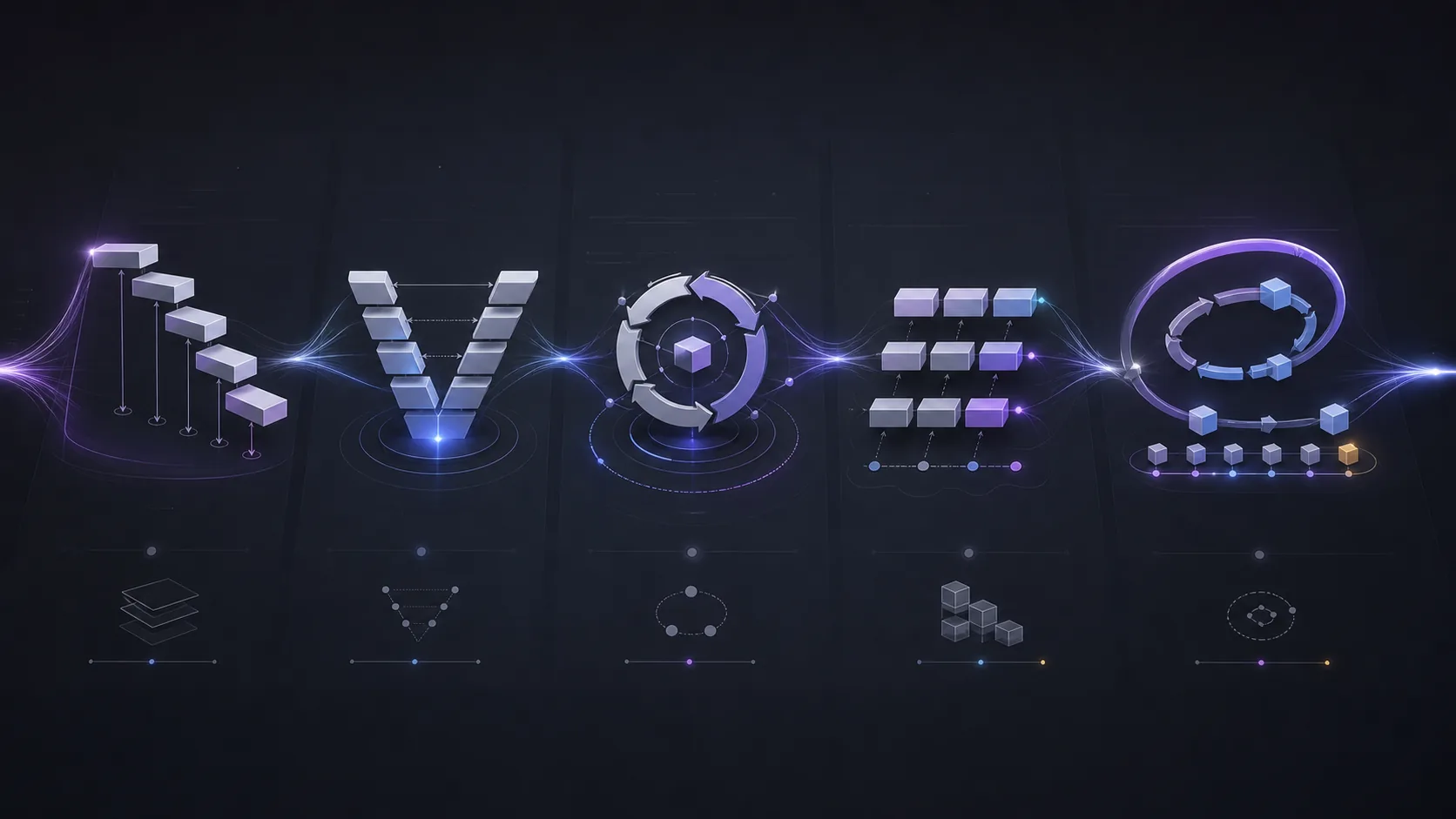
Choosing a software development model is less about following a fashionable process and more about matching the way work is organized to the reality of the product. A fixed-scope compliance project, an early MVP, and a fast-moving SaaS platform should not be managed in the same way.
The right model gives the team a shared rhythm for planning, building, testing, reviewing, and releasing. The wrong one hides risk until it is expensive, slows decisions, or creates constant rework. This guide narrows the landscape to five essential software development models every product owner and engineering lead should understand: Waterfall, V-model, Iterative, Incremental, and Agile.
Table of contents
- What is a software development model?
- Quick comparison of the top 5 models
- Waterfall model: best when the scope is stable
- V-model: Waterfall with stronger validation
- Iterative model: improve through repeated cycles
- Incremental model: ship value in usable slices
- Agile model: adapt through frequent delivery
- How to choose the right model
- A practical SynoIT recommendation
What is a software development model?
A software development model is the operating structure a team uses to move from idea to release. It defines how requirements are captured, when design happens, how development is sequenced, where testing fits, and how feedback changes the plan.
Good process does not remove uncertainty. It makes uncertainty visible early enough to handle. If stakeholders need formal sign-off, the model should support governance. If customers are still teaching you what the product should become, the model should support learning. If the system is risky, the model should force proof before heavy investment.
The five models below are not rigid labels. Mature teams often blend them. For example, a product team may use Agile delivery for most work, a Spiral-like proof phase for a risky AI feature, and V-model validation for regulated components. The goal is to choose the structure that protects momentum and quality.
Quick comparison of the top 5 models
| Model | Best for | Speed to first release | Flexibility | Main risk |
|---|---|---|---|---|
| Waterfall | Fixed-scope projects with clear requirements | Slow | Low | Expensive late changes |
| V-model | Regulated or safety-sensitive software | Slow | Low | Heavy upfront planning |
| Iterative | Products where the direction is clear but details need refinement | Medium | Medium | Endless loops without clear goals |
| Incremental | Modular products that can release useful parts early | Medium-fast | Medium | Poor integration between slices |
| Agile | Evolving products that need frequent feedback and delivery | Fast | High | Chaos without discipline and ownership |
Waterfall model: best when the scope is stable
Waterfall is the classic linear model. Work moves through fixed phases: requirements, design, development, testing, deployment, and maintenance. Each phase is expected to finish before the next begins.
This structure is useful when the project is predictable. If requirements are well understood, stakeholders can approve decisions upfront, and change is unlikely, Waterfall creates a calm delivery path. It also makes documentation, budgeting, and formal progress tracking easier because the scope is defined before major build work begins.
Waterfall becomes difficult when discovery happens late. If users, market conditions, or technical constraints force the team to rethink a requirement during testing, the cost can be high. Design, code, documentation, and test plans may all need to be revisited.
Use Waterfall when:
- Requirements are stable and agreed before development starts.
- The client or industry expects formal documentation and sign-offs.
- The cost of changing direction mid-project is higher than the cost of planning carefully.
Avoid relying on Waterfall when:
- The product needs real user feedback before the team can make confident decisions.
- The scope is likely to change during implementation.
- Speed to first learning matters more than upfront certainty.
V-model: Waterfall with stronger validation
The V-model keeps Waterfall’s staged structure but pairs each development phase with a matching testing phase. Requirements connect to acceptance testing, system design connects to system testing, architecture connects to integration testing, and implementation connects to unit testing.
That testing symmetry is the reason teams choose it. Instead of treating QA as a late checkpoint, the V-model asks the team to plan validation from the beginning. This can reduce ambiguity, improve traceability, and help regulated teams prove that the product was built against documented requirements.
The trade-off is weight. The V-model still depends on stable requirements, and it can slow delivery when teams need rapid experimentation. If priorities shift often, the test plan becomes another artifact that must be maintained.
Use the V-model when:
- Quality, compliance, or safety is central to the project.
- Requirements must be traceable from specification to test result.
- The team can invest in careful validation before release.
Be careful with the V-model when:
- The product is an MVP and major assumptions are still unproven.
- Stakeholders expect frequent scope changes.
- The team does not have enough QA capacity to maintain the validation plan.
Iterative model: improve through repeated cycles
The Iterative model works in repeated cycles. The team builds a version, reviews it, learns from feedback, and improves the next version. Instead of trying to perfect the product in one pass, the team expects refinement.
This model is useful when the overall direction is clear but the final details are not. A team may know that it needs a customer dashboard, for example, but not yet know which charts, filters, or workflows users will value most. Iteration lets the team build a workable version, observe behavior, and improve with evidence.
The risk is drifting. If every cycle opens new questions without a strong definition of done, the project can keep changing without reaching release quality. Iteration works best when each cycle has a clear objective, a review point, and a decision about what will and will not change next.
Use the Iterative model when:
- The product needs refinement through prototypes, demos, or user testing.
- The main direction is known, but feature details need discovery.
- Stakeholders are available for regular reviews.
Avoid an unbounded iterative process when:
- The contract requires a fixed scope and fixed price.
- The team cannot make decisions at the end of each cycle.
- Reviews become opinion sessions instead of learning checkpoints.
Incremental model: ship value in usable slices
Incremental development splits the product into usable releases. Each increment adds a meaningful piece of functionality. The first release may be small, but it should still be valuable.
This is different from iteration. Iteration repeatedly improves a version; incremental delivery expands the product piece by piece. A marketplace might launch browsing and booking first, then add payments, reviews, messaging, and analytics in later increments.
Incremental delivery helps teams create value sooner. It also gives stakeholders a practical way to prioritize: the most important slices go first, and lower-value features can wait until the core experience proves itself.
The danger is weak architecture. If increments are built as disconnected pieces, later integration becomes painful. The team needs enough upfront design to define shared data, interfaces, navigation, security rules, and performance expectations.
Use the Incremental model when:
- The product can be divided into useful modules.
- A smaller first release can still solve a real user problem.
- The team wants earlier market feedback without waiting for the full roadmap.
Watch out when:
- Features are too tightly coupled to release separately.
- A partial product would confuse users or damage trust.
- The team lacks integration discipline.
Agile model: adapt through frequent delivery
Agile is a family of approaches built around short cycles, working software, collaboration, and continuous adjustment. Scrum, Kanban, and Extreme Programming are common Agile methods, but the shared idea is simple: deliver value frequently, inspect the result, and adapt the plan.
Agile is powerful when requirements evolve. Instead of pretending the entire roadmap is fixed, the team keeps a prioritized backlog, works in manageable batches, reviews progress often, and updates priorities as new information arrives.
That flexibility does not mean “no process.” Strong Agile teams still plan, estimate, test, document, and protect quality. They define what done means, keep work-in-progress under control, and make sure someone owns product decisions. Without that discipline, Agile becomes constant reprioritization with very little completion.
Use Agile when:
- Requirements are expected to change.
- Frequent releases, demos, or stakeholder reviews are valuable.
- The team can collaborate closely and own quality.
Agile can struggle when:
- Stakeholders are unavailable for decisions.
- Priorities change daily with no product owner filtering requests.
- The team treats speed as permission to skip engineering standards.
How to choose the right model
Start with the shape of the work, not the name of the process. A useful decision should consider certainty, risk, release pressure, team maturity, and stakeholder availability.
Ask these questions before choosing:
- How stable are the requirements?
- What happens if a major assumption proves wrong late in the project?
- Do users need to test the product before the team can confidently continue?
- Can the product release in smaller slices without harming the experience?
- How much documentation, auditability, or formal approval is required?
- How often can stakeholders review work and make decisions?
- Does the team have the engineering discipline to support fast change?
Here is a simple rule of thumb:
| Situation | Strong starting point |
|---|---|
| Requirements are fixed and approval-heavy | Waterfall |
| Quality traceability is essential | V-model |
| You need to refine an idea through feedback | Iterative |
| You can release useful modules gradually | Incremental |
| Priorities evolve and speed matters | Agile |
A practical SynoIT recommendation
For most modern web products, SynoIT usually starts with an Agile or incremental delivery mindset, then adds structure where the project needs it. That means defining a clear MVP, shipping the highest-value slice early, reviewing with real users, and keeping quality practices active from day one.
Waterfall and V-model are still valuable when the environment demands predictability, documentation, and formal validation. Iterative work is useful when teams need to learn through prototypes. Incremental delivery is often the best bridge between business urgency and engineering control. Agile is strongest when the product will keep changing after launch.
The best model is the one your team can run consistently. A lightweight process followed well beats an impressive process nobody can maintain. Choose the model that matches your uncertainty, then give the team enough planning, feedback, and technical discipline to execute it with confidence.
SynoIT helps founders and product teams turn unclear product goals into practical delivery plans. If you are preparing an MVP, rebuilding a platform, or choosing the right development workflow, we can help you shape a roadmap that balances speed, quality, and adaptability.
Related post

When should you choose Sanity CMS? A practical decision guide
Sanity can be an exceptional content foundation when structured content, editorial workflows, and multi-channel delivery matter.
SynoIT Editorial Team
PRODUCT DELIVERY WORKSHOP
Choose the model your project can actually run.
SynoIT helps teams turn product uncertainty, delivery pressure, and engineering constraints into a practical development roadmap.
Plan your delivery model